What State Tests and Procedures are Recommended for My Baby?

Updated: Jan 19

Once your baby arrives, there are three standard tests performed to ensure your baby is in good health. All three are required in all fifty states and include the newborn screen, Critical Congenital Heart Disease screening (CCHD), and a hearing screen.
Newborn Metabolic Screen
All 50 states require newborn metabolic screening to test for or a group of health disorders that can cause serious health problems for your baby if they go undetected. There are between 32 to 60 or more conditions that the screen tests for, depending on the state you live in. To find out what your state tests for, visit Baby’s First Test.
The test requires a blood sample from your baby’s heel and starts by warming the heel to bring blood close to the surface. The heel is then pricked to draw blood. Sometimes, the baby must be pricked more than once. Blood is collected in circles on blotter paper, which is submitted to a laboratory.
If tests are abnormal, additional testing must be done immediately to confirm and treat the condition. There is not an alternative test. Once symptoms of these diseases are noticeable, your baby may have suffered irreversible damage.
In most cases, state laws require the screen to be performed between 24-48 hours. In other instances, screening is recommended no sooner than 48 hours after birth and before five days. Some states routinely test infants twice. If you are seeing a midwife and she cannot perform this screen, you should see a pediatrician to have this screen performed.

Critical Congenital Heart Disease Screen
Critical congenital heart disease (CCHD) describes a group of serious heart defects that can lead to life-threatening complications for affected babies, occurring in 18 per 10,000 newborns each year. Although babies may appear healthy initially, signs and symptoms can prompt immediate emergency care within hours or days.
Screening for CCHD is simple. The test is non-invasive and is performed using a handheld pulse oximeter with a sensor wrapped around the foot or hand to read the oxygen levels. It is read as a PASS or FAIL. It is important to note that a “PASS” does not exclude the existence of a cardiac disorder.
The standard time frame for performing the screen is within 24 to 48 hours. This is easy to accomplish in the hospital, as mom and baby aren’t discharged for 24 to 48 hours. However, the feasibility for homebirth midwives to test within this timeframe has prompted studies to look into early testing. Several studies (Ewer, Cawsey, Narayen) confirm that pulse oximetry performed within hours of birth is acceptable for early discharge and also has the potential to detect early newborn problems.
If your midwife is unable to perform this screen, you should see a pediatrician to have this screen performed.

Newborn Hearing Screen
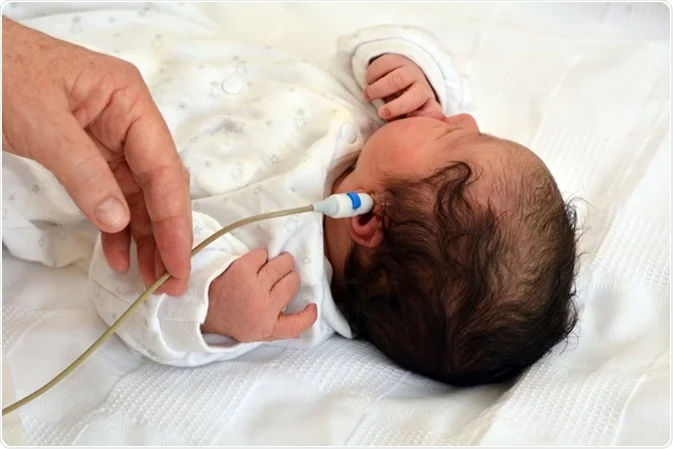
Your newborn’s hearing will need to be screened, usually within the first 30 days after birth. In the hospital, this is performed before you leave. When having a home or birth center birth, you may be referred, though some midwives have a hearing machine and can screen your newborn themselves. If your midwife cannot perform this screen, you should see an audiologist or pediatrician to have this screen performed.
Out of every thousand children born in the U.S., approximately 2-3 of them will be born deaf. The purpose of the hearing screen is to ensure that all babies with suspected hearing loss can benefit from early intervention to assist with language development.
Sources
National Institute of Health, National Library of Medicine, Accuracy of Pulse Oximetry Screening for Critical Congenital Heart Defects after Home Birth and Early Postnatal Discharge. J Pediatr. June 2018.
National Institute of Health, National Library of Medicine, Evaluation of a Screening Program to Detect Critical Congenital Heart Defects in Newborns.. April 2017.
National Institute of Health, National Library of Medicine, Feasibility of pulse oximetry screening for critical congenital heart defects in homebirths. Arch Dis Child Fetal Neonatal Ed. July 2016.
National Institute of Health, National Library of Medicine, Legal issues in newborn screening: implications for public health practice and policy.. January/February 2006.
National Institute of Health, National Library of Medicine, Pulse Oximetry Screening for Critical Congenital Heart Disease after Home Birth and Early Discharge. J Pediatr. March 2016.
National Institute of Health, National Library of Medicine, Pulse oximetry screening for critical congenital heart defects. Cochrane Database Syst Rev. March 2018.
Pediatrics, Newborn Pulse Oximetry Screening: Which Algorithm Is Best? November 2016.
Wiley Online Library, Newborn Screening Test. Journal of Midwifery & Women’s Health, June 2016.


Comments